The Rise of AI in Recruiting: What Works and What's Hype
Every recruiting tool launched in the last three years has "AI" somewhere in the pitch deck. Every single one.
I've worked for many startups, including ones that put AI in the marketing before it was in the product. So let me be honest about what AI actually does well in recruiting, what's hype, and where Candyfloss AI uses it versus where we don't.
What AI Actually Does Well
Search and Query Understanding. You type "senior ML engineer who's worked with production recommendation systems" and the system understands what you mean. At Candyfloss AI, our query builder uses an LLM to parse natural language and extract structured criteria. The AI handles interpretation, but the search itself is deterministic. Not a black box.
Summarization and Data Extraction. Extracting skills from unstructured bios. Summarizing career trajectories from messy data. Classifying companies by industry. These are bounded tasks where AI consistently outperforms manual work.
Pattern Matching at Scale. Understanding that "React Native" and "ReactNative" are the same thing. That "Staff Engineer" at a startup and "Principal Engineer" at a big company might be equivalent. Semantic understanding across millions of records.

What AI Is Terrible At
Predicting Culture Fit. If a recruiting tool tells you their AI can assess culture fit, run. An AI model trained on your last 50 hires will learn your biases, not your culture.
Eliminating Bias. AI models inherit whatever biases exist in their training data, often amplifying them. Amazon scrapped their AI recruiting tool because it penalized resumes mentioning "women's". The fundamental problem hasn't changed.
Predicting Job Performance. The variables are too numerous and context-dependent. Any tool claiming performance prediction with a confidence score is selling noise dressed as signal.
Replacing the Actual Conversation. 67% of candidates rated their experience with AI screening chatbots as "poor" or "very poor."
Where We Draw the Line at Candyfloss AI
We use AI for: Query understanding, skills extraction, company classification, profile summarization.
We don't use AI for: Ranking by "fit", automated outreach, predicting responses, making hire/no-hire recommendations.
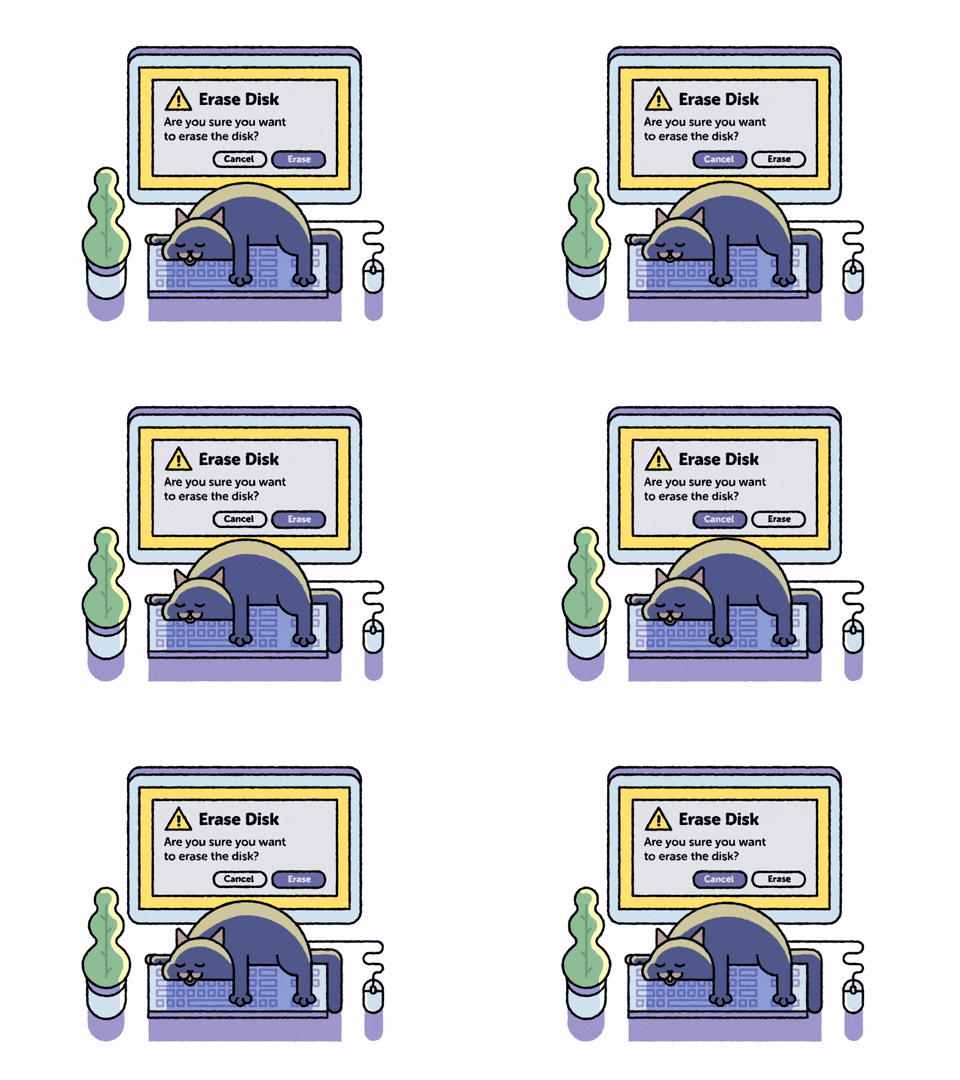
The line is simple: AI should help you find information faster. It should not make decisions for you.
How to Evaluate AI Claims
Ask: "What specifically does the AI do?" "Can I see the logic?" "What data was it trained on?" "What happens when it's wrong?" "Is it replacing a human task or augmenting it?"
The best recruiting teams use AI for the data-heavy, repetitive parts so they can spend more time on the parts that require a human: understanding teams, building relationships, and making nuanced decisions.